Salmon don’t just live and die. They deliver.
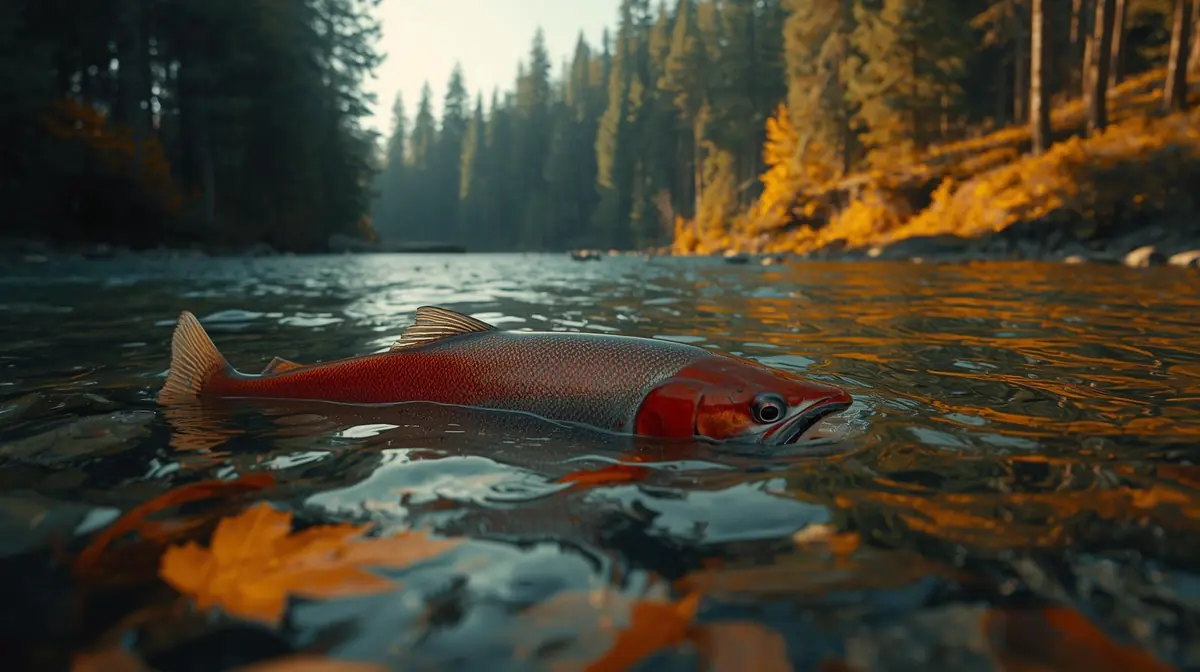
Every autumn, Pacific salmon return from years in the open ocean to the rivers where they were born. They navigate thousands of kilometres by smell, fight upstream against current and gravity, spawn — and then die. Their bodies litter riverbanks by the millions.
To a casual observer, it looks like mass death. To an ecosystem, it’s a delivery of nutrients from the deep ocean.
The mechanism is called marine-derived nutrient cycling, and its scale is difficult to overstate. A single adult salmon carries substantial concentrations of nitrogen and phosphorus — elements that are genuinely scarce in the forest soils of the Pacific Northwest. When salmon die, those nutrients enter the food web from dozens of angles at once.
Bears pull carcasses from the water and drag them inland, sometimes hundreds of metres into the forest, where they eat the fatty parts and leave the rest. Eagles and ravens pick at what remains. Insects colonise the carcass. Flies lay eggs. Beetles arrive. Each creature that feeds on salmon tissue eventually deposits nutrients back into the soil through waste and decay. The nitrogen that once circulated through seawater ends up locked into tree rings.
Studies have found measurable differences in the growth rates of riparian trees — trees growing along salmon streams — compared to trees of the same species growing beside rivers without salmon runs. Researchers have detected marine-derived nitrogen in tree tissue well back from the riverbank. The forest literally grows faster when the salmon run is strong.
The relationship runs deeper still. Stream-dwelling insects that emerge as adults — stoneflies, mayflies, caddisflies — carry marine-derived nutrients out of the water and into the surrounding forest when they’re eaten by spiders, bats, and birds. The nutrients radiate outward in waves, carried by thousands of tiny bodies.
What makes this particularly striking is the time lag involved. Salmon spend two to seven years at sea before returning to spawn. The nutrients they carry home were captured from ocean productivity years earlier, in waters hundreds of kilometres away. In a very real sense, the productivity of the North Pacific shapes the growth of inland forests.
When salmon runs collapse — through overfishing, habitat destruction, or dams blocking migration routes — the forests feel it. Not immediately, and not dramatically, but measurably. Trees grow more slowly. Soil nitrogen levels drop. The whole system runs a little leaner.
The salmon are not just fish in a river. They’re a pipeline between ocean and mountain. Their death is an act of ecological generosity that took millions of years to evolve, and it sustains ecosystems that have no other way to access what lies beneath the sea.
Dead salmon don’t end things. They start them.