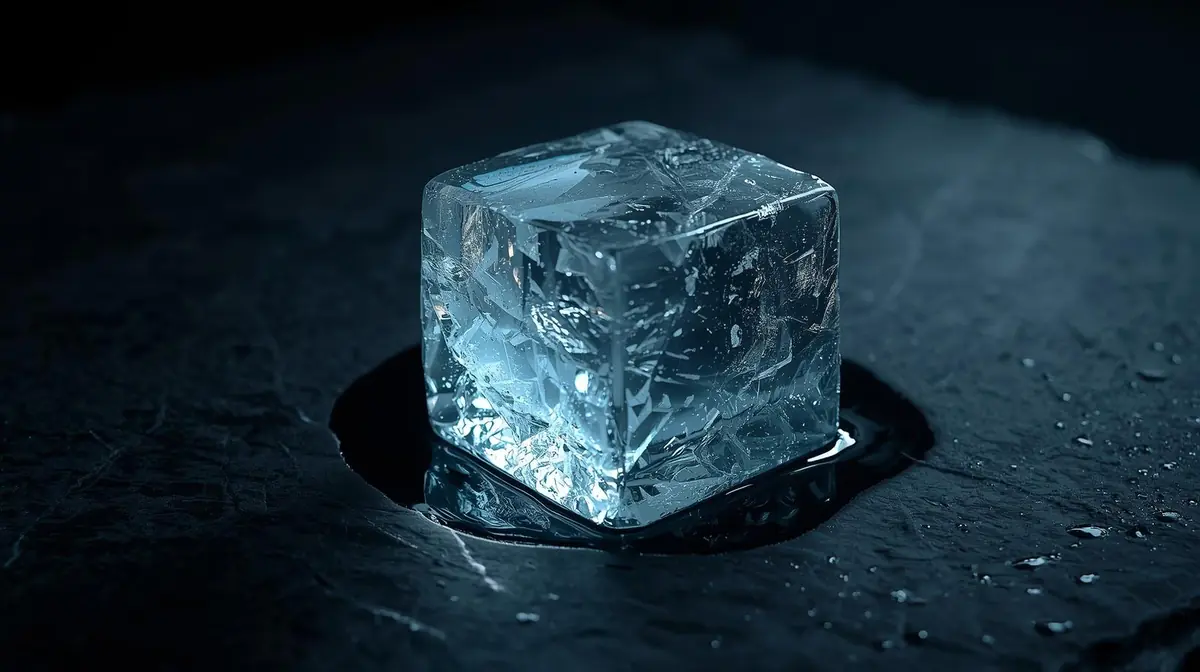
The question sounds simple enough: why is ice slippery? Most people answer with something about pressure — a skate blade’s weight melts a thin layer, creating a film of liquid water to glide on. It sounds plausible. It’s also mostly wrong.
The pressure-melting theory, known as regelation, dates to the 19th century. The physics isn’t false — pressure does lower ice’s melting point — but the numbers fall apart under scrutiny. A 70 kg skater on a blade creates far too little pressure to meaningfully melt ice at typical skating temperatures. To lower the melting point from 0°C to -10°C, you’d need roughly 130 atmospheres of pressure. A skate blade doesn’t come close. If regelation were the whole story, ice rinks would be essentially impossible to use in winter.
The real answer was intuited earlier — by Michael Faraday, in the 1850s. He pressed two pieces of ice together and noticed they fused, even without applying heat. His conclusion: there must already be a liquid-like layer on the ice surface before any external force is applied.
He was right, and modern surface science confirms it. Water molecules at the very outermost layer of ice are less constrained than those deeper inside. They have fewer neighbors to bond with, so they vibrate more freely and behave less like a solid. This disordered zone — called a quasi-liquid layer, or premelting — exists naturally at the ice surface, even at temperatures well below freezing.
That thin, slippery veneer is present even when no one has touched the ice — an invisible, molecular-scale film that reduces friction before anything begins to move. It’s what makes skating, sledding, and black ice genuinely dangerous.
One strong piece of evidence: ice becomes significantly less slippery at very low temperatures, like -30°C. At those extremes, the quasi-liquid layer thins and nearly disappears. Skaters and athletes who compete in extreme cold find the ice almost grabby by comparison. Roads at -20°C often have better traction than roads near zero — a counterintuitive fact that catches many drivers off guard.
This also explains several other ice behaviors. Glacier ice flows slowly under its own weight because adjacent crystals slide along their quasi-liquid surfaces. Snow packs into a ball when squeezed because you’re briefly thickening the premelted layer between crystals. At -25°C, snow barely packs at all — the crystals lose that lubricating interface.
The pressure-melting shortcut isn’t a dangerous lie, but it obscures something more interesting: ice is fundamentally restless at its surface. It doesn’t wait to be pressured into being slippery. The liquid is already there, hovering at the edge of phase transition, making every frozen surface a little less stable than it looks.
Next time you slip on ice, you’re not melting it. You’re riding a surface that was never quite solid to begin with.