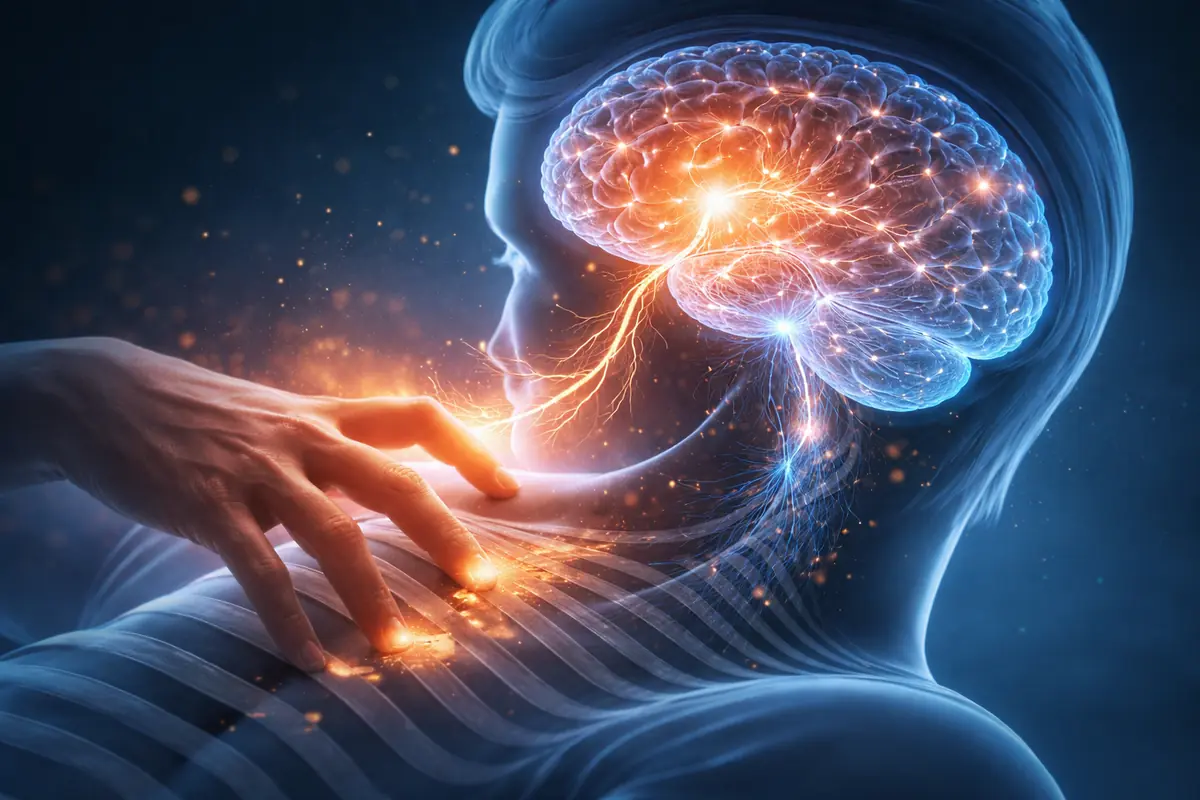
Try it right now. Wiggle your fingers against your ribs, your neck, or the soles of your feet. No laughter. No uncontrollable squirming. Just mild pressure. Yet the moment someone else does the exact same thing, your body reacts instantly. Why?
The answer lies deep inside your brain — and it reveals something remarkable about how you experience reality.
Tickling works because it’s unexpected. When another person reaches toward you, your brain doesn’t know exactly when, where, or how the touch will land. That uncertainty triggers a sensory overload, mixing touch, anticipation, and reflex. Laughter is not the cause of tickling — it’s the result of your nervous system being surprised.
When you try to tickle yourself, your brain removes that surprise entirely.
Every time you move, your brain sends two signals at once. One goes to your muscles, telling them what to do. The other is a prediction sent to your sensory system, saying, “This is about to happen.” When the touch occurs exactly as predicted, the brain dampens the sensation before it even reaches your awareness. The result is a neutral feeling instead of a ticklish one.
This process is known as sensory attenuation, and it helps your brain focus on what actually matters. Without it, every movement you made would feel overwhelming. Walking would feel like being constantly poked. Breathing would feel intrusive. Even blinking would become distracting.
In other words, your brain is constantly editing reality on your behalf. It lowers the volume on expected sensations so that unexpected ones stand out. That makes the world manageable instead of chaotic.
Scientists have demonstrated this effect in experiments using robotic arms. When participants controlled the robot themselves, the touch felt weak or unremarkable. But when the robot moved independently — even by a fraction of a second — the same touch suddenly felt ticklish again. That tiny delay was enough to fool the brain.
That result is revealing because it shows how little uncertainty the brain needs to change its response. Ticklishness is not only about touch. It is about prediction failing at the edge.
This ability to predict yourself doesn’t just affect tickling. It plays a role in balance, coordination, and even mental health. Some researchers believe disruptions in this prediction system may contribute to conditions where people feel disconnected from their own actions or thoughts.
In other words, your brain is constantly editing reality — turning down sensations it expects and amplifying the ones it doesn’t.
That editing is one reason the world feels manageable. If everything you predicted felt as intense as everything that surprised you, attention would become exhausting noise.
So the next time someone makes you laugh with a simple tickle, remember: it’s not their fingers doing the work. It’s your brain, briefly caught off guard, and reacting exactly as it was designed to.