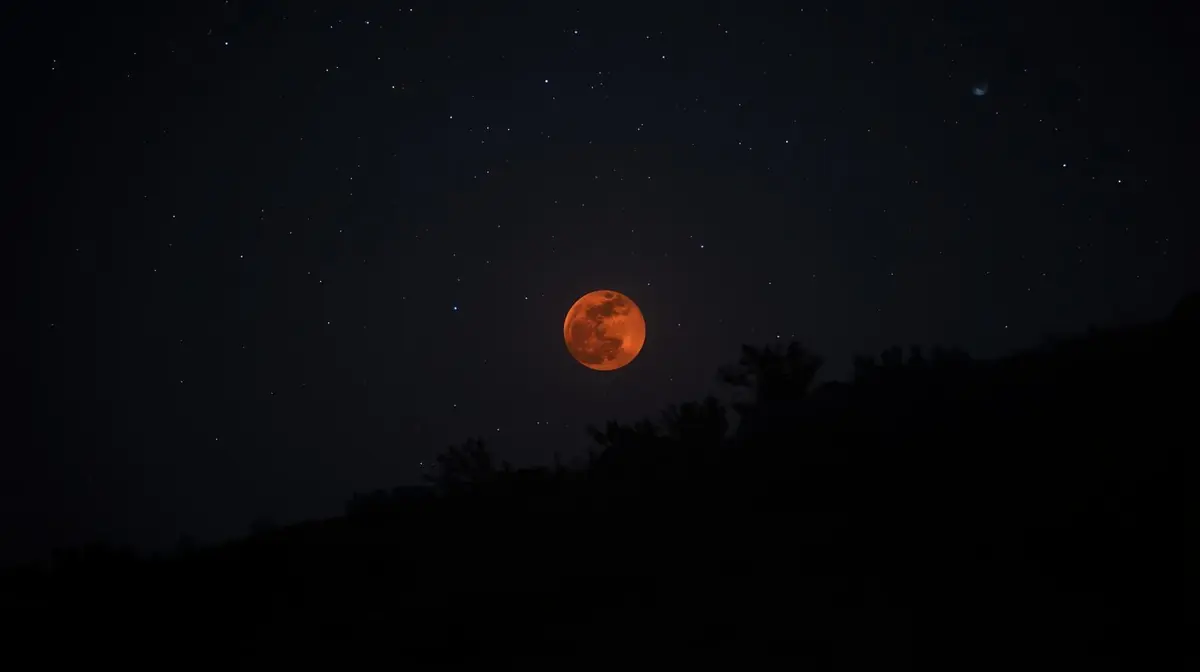
A total lunar eclipse is one of those astronomical events that requires nothing from the observer except time and a clear sky. No telescope, no protective glasses, no technical knowledge. Just look up. And what you’ll see — a Moon that turns copper-red or burnt orange for up to an hour — is genuinely strange enough to stop people in their tracks.
The total lunar eclipse anticipated in March 2026 is already drawing attention for reasons that apply to every eclipse in its class: it’s part of the total variety, which produces the so-called blood moon effect, and it falls in a calendar stretch when sky-watching conditions across much of the northern hemisphere can be reliably crisp.
The mechanics are elegant. A total lunar eclipse happens when Earth passes directly between the Sun and the Moon, casting its shadow across the lunar surface. But the Moon doesn’t go dark. Earth’s atmosphere refracts sunlight around its edges — bending the longer red wavelengths inward while scattering shorter blue ones away. The result is that every sunrise and sunset on Earth simultaneously illuminates the Moon in a ring of light that stains it red.
The exact shade varies. In the years after significant volcanic eruptions, more atmospheric particulates scatter light differently, producing darker and more muted eclipses. In cleaner atmospheric conditions, the Moon glows a vivid amber. That variability is part of the draw: you never quite know what you’ll get until you’re watching it.
What makes any total lunar eclipse worth noting — and the March 2026 event is no exception — is the combination of accessibility, duration, and the simple fact that it’s free to watch. Total lunar eclipses aren’t rare in absolute terms, but a totality with a convenient viewing window, one that doesn’t require a 3am alarm or a trip to a dark-sky site, occurs less often than the orbital mechanics suggest. It also doesn’t compete with artificial light the way faint celestial events do — a total lunar eclipse is bright enough to see from the middle of a city. When the geometry aligns well, it tends to create one of those shared cultural moments where people step outside in suburbs that rarely go dark.
Astronomers, for their part, tend to appreciate eclipses less for what they discover and more for what they confirm. The Earth-Moon-Sun geometry is well understood. But watching the shadow creep across the Moon’s surface in real time has a different quality from reading about it — it makes the solar system feel physically present rather than abstract.
For casual observers, the March 2026 eclipse offers a rare opportunity to see something genuinely unusual without equipment, preparation, or expertise. The window between now and then is long enough to mark the calendar and forget about it, then be pleasantly reminded.
The only real preparation required is noticing when the Moon rises.