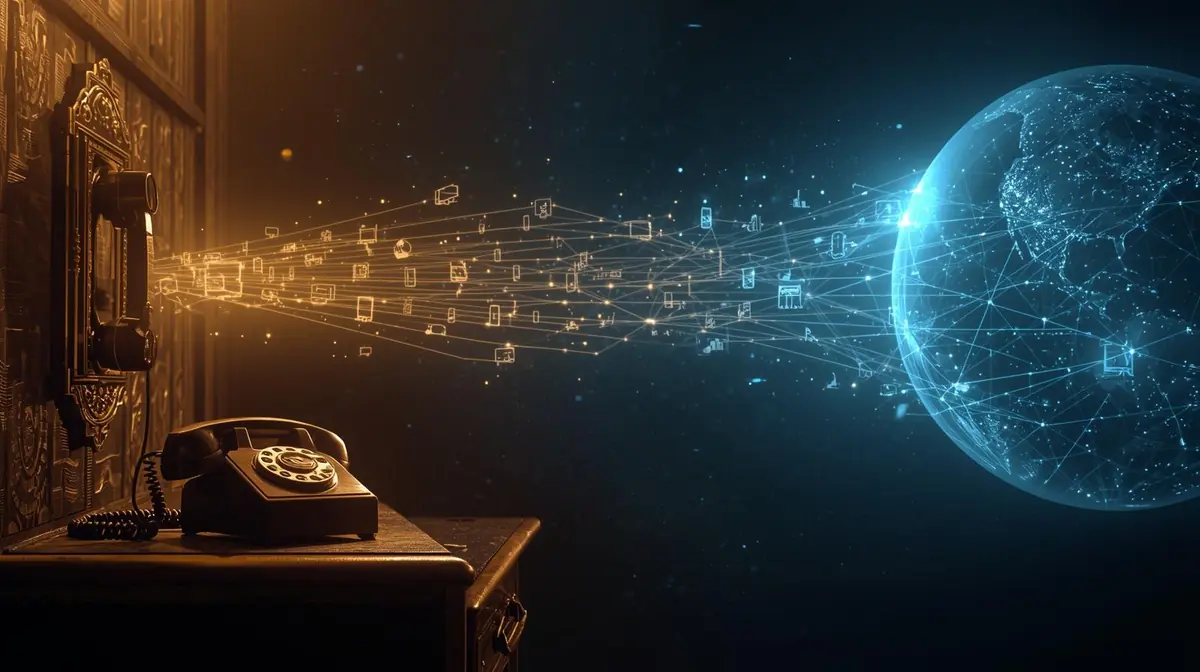
For most of the last century, communication infrastructure was a solved problem. The telephone worked. Email worked. Messaging worked. Nobody spent much time marvelling at the fact that two people could exchange words across thousands of miles in real time — it was simply what life was like.
AI has changed that. Not by inventing a new kind of communication, but by making the mechanics of communication legible again.
The shift is subtle but noticeable. Conversations about large language models — how they process language, predict meaning, generate response — have turned ordinary people into amateur linguists and historians of information. Questions that seemed irrelevant for decades have come back into circulation: What exactly is a message? Where does meaning live — in the words or in the understanding? Can a thing communicate if it doesn’t experience anything?
These questions aren’t new. They were live in the 1840s, when the telegraph first let people send words faster than a horse could carry them. They were live again in 1876, when Alexander Graham Bell’s telephone transmitted voice over wire for the first time and observers struggled to articulate what, exactly, had just changed. They came up again with radio, with television, with the internet. Each wave of communication technology forced the same underlying reckoning: what do we mean when we say we’re talking to each other?
What’s interesting about the AI moment is how directly it forces that question. A language model doesn’t just transmit your words — it generates its own. And that distinction — between transmission and generation — is suddenly important in a way it hadn’t been since the early telephone era, when people genuinely debated whether the voice they heard through a receiver was the voice of a person or some mechanical copy of it.
Historians of communication have noticed the renewed interest. Work on the telegraph, the early telephone network, and the postal system — subjects that might once have seemed narrowly academic — has found new popular resonance because it gives people a frame for what’s happening now. Old inventions feel fresh not because they’ve changed, but because the questions they originally raised have come back.
There’s a useful mental model in this. Each major communication technology looks obvious in retrospect: of course people wanted to transmit voice; of course they wanted instant text. But at the time, each invention forced a reexamination of what communication was for and what it meant to connect. AI is doing the same, just with language as the subject rather than distance.
The telephone stopped being remarkable around the time it became invisible. If the pattern holds, AI communication tools will follow the same path. But right now, they’re in the same phase as Bell’s early demonstrations — strange, contested, and genuinely thought-provoking in ways that older, settled technologies no longer are.
The reason old inventions feel fresh again is that new ones have reminded us what invention actually asks of us.