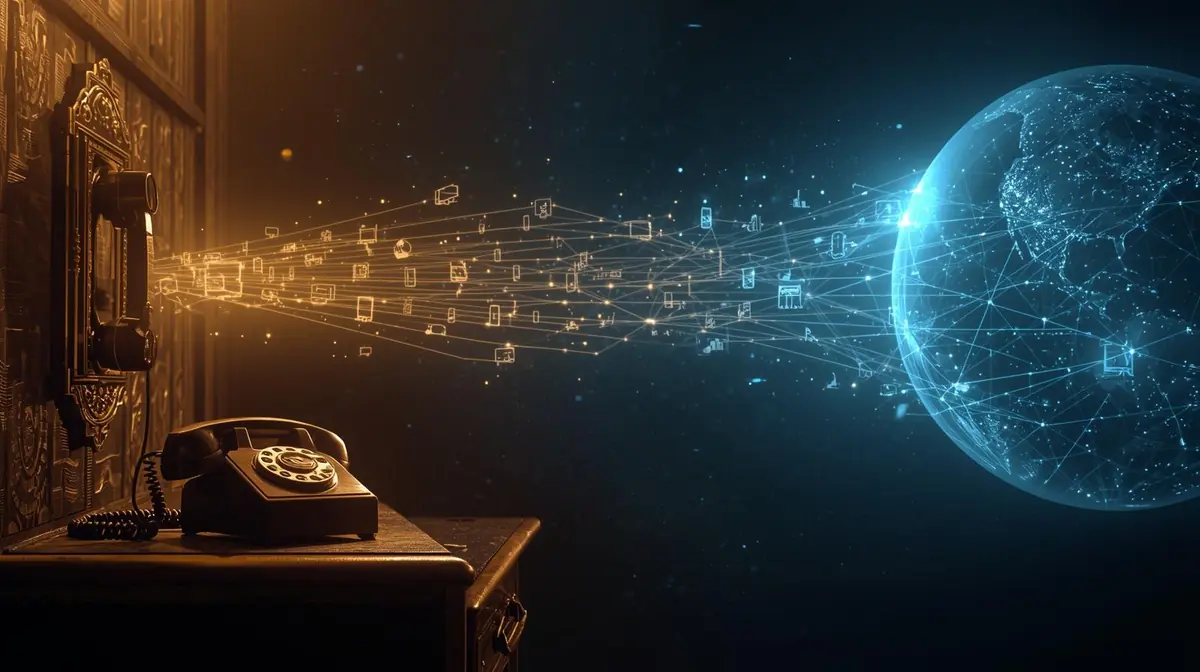
On March 10, 1876, a simple sentence changed the world. Alexander Graham Bell spoke the words: “Mr. Watson, come here, I want to see you.” It was the first telephone call ever made.
At the time, it seemed almost magical. A voice traveled through a wire from one room to another. Today, that moment feels almost quaint. We carry smartphones capable of connecting us instantly to people across continents through voice, video, and even artificial intelligence. Yet the story of the telephone isn’t just about technology. It’s about something deeper: the human need to connect.
The Speed of Change
Communication technology rarely stays still. The telephone led to radio, television, and eventually mobile phones. Each leap didn’t just improve convenience — it reshaped society.
Businesses suddenly expanded across borders. Families separated by oceans could speak to one another in real time. Information moved faster than ever before.
What started as a fragile wire between two rooms evolved into a global network connecting billions of people. Today, a video call can travel across satellites and fiber cables in a fraction of a second. The world has never felt smaller.
When Connection Becomes Noise
Ironically, the explosion of communication tools has created a new challenge. We are now surrounded by messages, alerts, emails, and social feeds competing for attention.
More communication does not automatically mean better communication.
That is one reason the history of the telephone still feels relevant. Every new communication tool promises greater reach, but each one also changes the texture of human attention. The question is never only whether the technology works. It is whether it helps people feel more understood once it does.
Bell’s first call had a clear purpose. It was simple, direct, and human. Many modern interactions, however, are fragmented or rushed. Notifications interrupt conversations. Messages pile up faster than we can meaningfully respond.
In a world of constant connectivity, the rarest skill may no longer be speaking — but listening.
The Next Leap
The future of communication may soon move beyond screens entirely. Researchers are experimenting with brain-computer interfaces, holographic meetings, and AI systems that translate languages instantly.
These innovations promise incredible possibilities. A person could speak naturally while technology bridges language barriers in real time. Meetings could feel as if everyone is in the same room, even when separated by thousands of kilometers.
But technology alone will not determine whether these tools improve our lives. That choice belongs to us.
The Real Lesson
One hundred and fifty years after Bell’s famous call, the most important breakthrough wasn’t the device itself.
It was the simple act of reaching out.
Technology will keep evolving. Devices will become faster, smarter, and more immersive. But the heart of communication will remain unchanged: someone, somewhere, wants to be heard.
And sometimes, all it takes to change the world is a voice saying hello.