Budgets fail for a boring reason: they ask you to be disciplined every single day.
Track every coffee. Categorize every grocery slip. Remember every subscription. Then feel guilty when real life happens. Most people don’t need a more detailed budget — they need a system that works even when motivation disappears.
That’s where the Anti-Budget comes in.
It’s not “no budget.” It’s a budget that runs quietly in the background, with one rule: pay yourself first and automate the rest.
The Anti-Budget in One Sentence
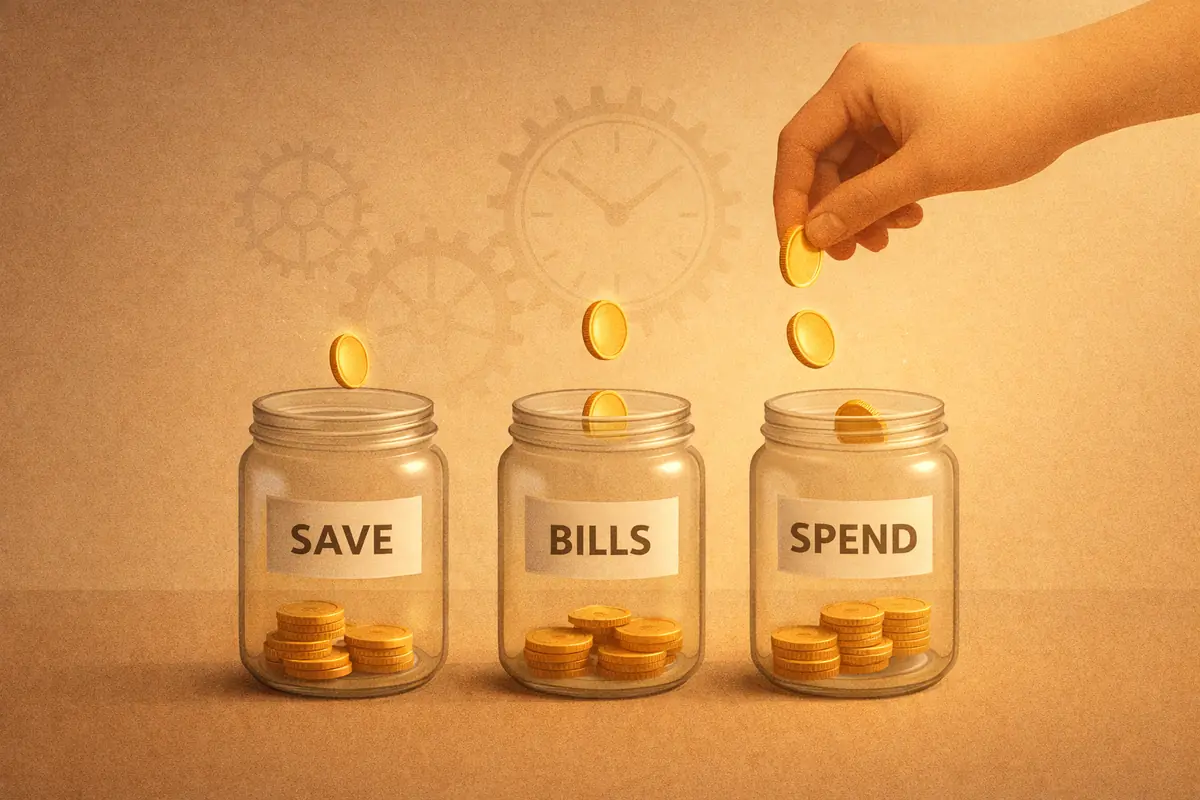
Before you spend a cent, you send money to three places:
- Savings / Investing
- Bills
- Spending
Once those are covered, whatever is left is yours to use — guilt-free.
Step 1: Pick One “Payday Move”
Choose a percentage or fixed amount that moves automatically on payday.
Examples that work for normal humans:
- 5% of income to savings (easy win)
- 10% if you’re serious about momentum
- A fixed amount like R500 a month if income varies
The key is not the number — it’s the automation. If you wait to “see what’s left,” there will never be anything left.
That is the psychological advantage of the anti-budget. It removes repeated decision-making from the place where people usually fail. You do not keep proving discipline. You install it once and let the system keep working.
Step 2: Split Your Money Into Simple Buckets
You don’t need 18 categories. You need clarity.
Try these three buckets:
- Future You (Save/Invest): emergency fund, retirement, goals
- Life (Bills): rent, fuel, insurance, school fees
- Now (Spend): groceries, fun, takeaways, impulse buys
If your bank supports it, create separate accounts (or sub-accounts). If not, use separate “virtual pockets” in whatever finance app you already use.
Step 3: Make Spending “Harder” Than Saving
This is the secret sauce.
Do not attach your card to the Savings account. Don’t keep it in the same place you swipe from daily. Make saving the default and spending the conscious action.
A simple setup that works:
- Salary lands in your main account
- Auto-transfer to Savings immediately
- Auto-pay Bills from a bills account
- Keep one card for your Spend account
Now your lifestyle naturally matches your plan.
That matters because good money systems should reduce friction, not increase it. If your setup is too complicated to survive a tired week, it is not a system. It is a hobby.
The Twist: Freedom Is the Feature
The Anti-Budget isn’t about restriction. It’s about permission.
Once you’ve paid Future You and covered Life, your spending money is truly yours — no spreadsheets, no shame, no “I’ll start next month.”
You don’t need perfect tracking. You need a system that keeps working on your messiest weeks.