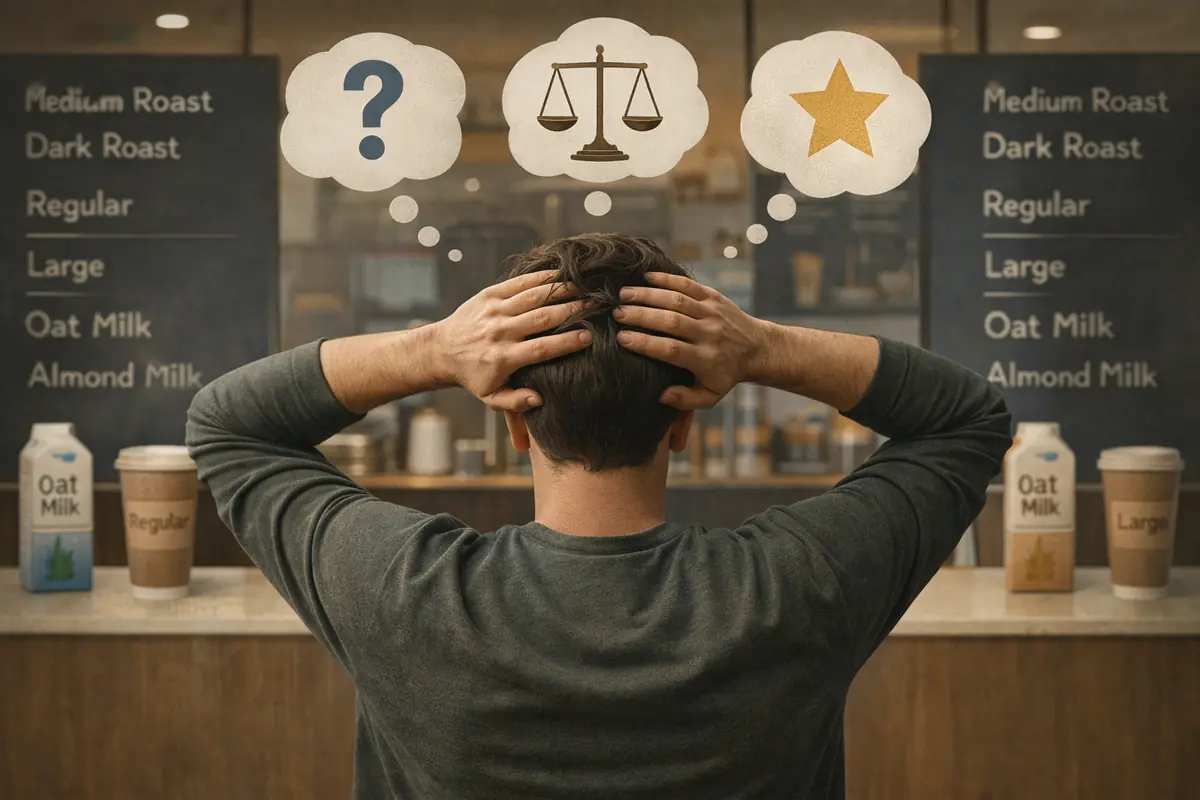
Choosing a coffee shouldn’t be stressful. Yet somehow, standing in front of five similar options can feel overwhelming. Medium roast or dark roast? Oat milk or almond? Large or regular?
Small decisions often carry outsized mental weight. Why?
Overthinking is rarely about the decision itself. It’s about consequences — real or imagined. The mind tries to predict outcomes, avoid regret, and minimize mistakes. Even simple choices trigger a quiet internal question: “What if I choose wrong?”
That question sounds responsible, which is why overthinking often disguises itself as wisdom. But many everyday decisions do not become better because you spend more time looping around them. They become heavier.
Part of the problem is abundance. Modern life offers more options than ever before. More careers, more products, more information, more opinions. While choice is a privilege, too much of it can exhaust the brain. Psychologists call this decision fatigue — the mental strain that builds after making repeated choices.
The more options we see, the more comparisons we run. Each possibility creates a mini-simulation in our head. We imagine outcomes, reactions, and future scenarios. Multiply that by dozens of daily decisions, and it’s no surprise we feel mentally drained.
Another hidden driver is perfectionism. Many people unconsciously believe there is a “best” choice — not just a good one. This raises the stakes unnecessarily. Instead of picking what works, we hunt for what’s optimal. That search rarely ends.
There is also identity wrapped up in minor choices now. People do not just choose a product, a meal, or a routine. They feel as if they are choosing what kind of person they are. That inflates the pressure around decisions that should stay ordinary.
Ironically, overthinking can reduce satisfaction. Studies show that people who constantly evaluate alternatives after deciding tend to feel less happy with their choice. The mind keeps wondering about the path not taken.
So how do we quiet the mental noise?
First, separate high-stakes decisions from low-stakes ones. Not every choice deserves equal energy. What you order for lunch rarely shapes your life trajectory. Save your mental bandwidth for decisions that truly matter.
Second, set limits. Give yourself a time boundary — two minutes to choose, then commit. Constraints reduce mental spirals.
Third, accept imperfection. Most decisions are adjustable. You can change brands, try a different routine, pivot careers, or revise plans. Few choices are final.
The goal is not to become careless. It is to become proportional. Good judgment means giving the right amount of attention to the right kind of choice.
Clarity often comes not from thinking more, but from thinking less. Once you recognize that many decisions carry minimal long-term impact, the pressure softens.
Overthinking feels responsible, but sometimes it’s just fear disguised as caution. And often, the best decision is simply the one you confidently move forward with.
Because progress beats perfection — every time.