Tardigrades: The Toughest Animals on Earth Are Not Indestructible
Tardigrades can survive space, deep freezing and decades without water. But the popular story of an unkillable animal leaves out the interesting part.
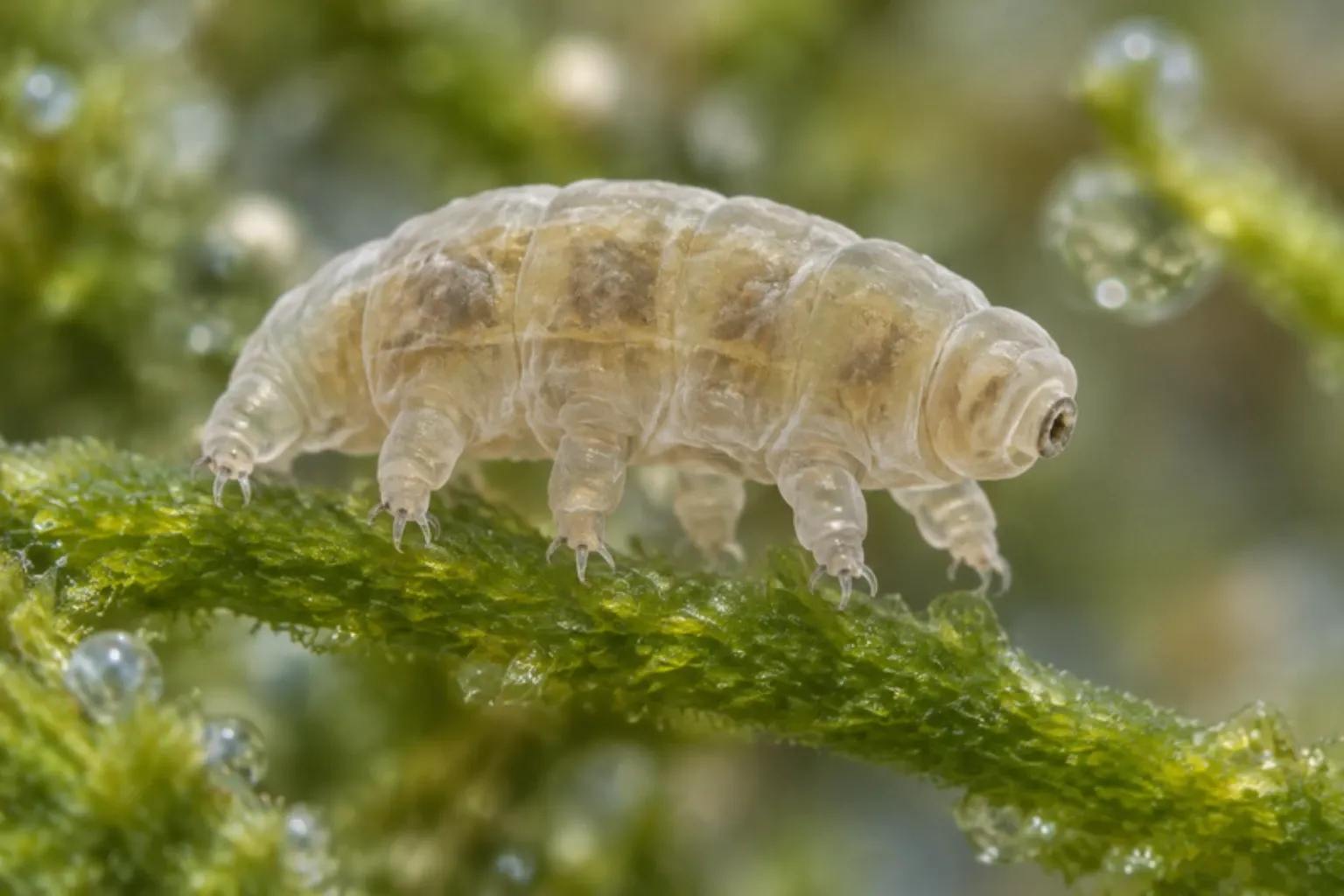
Tardigrades are about half a millimetre long, have eight stubby legs, and move with a slow, lumbering gait. In 1773 the German pastor Johann Goeze called them “little water bears”. A few years later the Italian biologist Lazzaro Spallanzani gave them the name that stuck: tardigrada, or “slow steppers”.
More than 1,300 species are known. They live almost everywhere: in moss and lichen, in soil, in the deep sea, on mountain tops and in Antarctic ice.
The trick: switching life off
A tardigrade’s reputation rests on one ability. When its surroundings dry out, it pulls in its legs, curls into a shrivelled ball called a tun, and loses almost all of its body water. Its metabolism drops to levels that are barely measurable.
In this state, tardigrades have survived:
- Space. In 2007, tardigrades rode on the outside of a satellite. Many survived the vacuum, and a few even survived unfiltered solar radiation.
- Time. Japanese researchers revived tardigrades from a moss sample that had been frozen in 1983. One of them went on to lay eggs.
- Radiation. They tolerate radiation doses roughly a thousand times higher than would kill a human.
How they do it
Two discoveries explain part of the trick. In 2016, scientists found a protein called Dsup that binds to a tardigrade’s DNA and shields it. Human cells engineered to produce it suffered about 40% less damage from X-rays.
A year later, another team found proteins unique to tardigrades that turn into a glass-like solid as the animal dries out. That glass holds its cells and molecules in place until water returns.
Where the legend breaks down
The tardigrade’s toughness is real, but “indestructible” is not.
- Awake, they are fragile. In a 2020 experiment, half of a group of active tardigrades died after a day at about 37 °C: a hot summer afternoon. Even dried tuns died in large numbers when held at around 63 °C for a day.
- They have limits on impact. In 2019 an Israeli lunar lander carrying dried tardigrades crashed on the Moon. Later tests fired tardigrades from a gun: they survived impacts up to about 900 metres per second but not faster, so the lunar stowaways very probably did not survive.
- They need water to live. A tun is waiting, not living. It cannot eat, grow or reproduce until it is wet again.
The takeaway
Tardigrades are not superheroes. They are specialists in pausing life when conditions turn bad. That makes them some of the most resilient animals known, and a working model for researchers trying to store vaccines and cells without refrigeration.
Sources & further reading
- 01Jönsson, K. I. et al. (2008). Tardigrades survive exposure to space in low Earth orbit. Current Biology.
- 02Tsujimoto, M. et al. (2016). Recovery and reproduction of an Antarctic tardigrade retrieved from a moss sample frozen for over 30 years. Cryobiology.
- 03Hashimoto, T. et al. (2016). Extremotolerant tardigrade genome and improved radiotolerance of human cultured cells by tardigrade-unique protein. Nature Communications.
- 04Boothby, T. C. et al. (2017). Tardigrades use intrinsically disordered proteins to survive desiccation. Molecular Cell.
- 05Neves, R. C. et al. (2020). Thermotolerance experiments on active and desiccated states of Ramazzottius varieornatus. Scientific Reports.
- 06Traspas, A. & Burchell, M. J. (2021). Tardigrade survival limits in high-speed impacts. Astrobiology.