The Polar Bear's Hidden Colours: A Dark Tongue, Black Skin and Fur That Isn't White
Look inside a polar bear's mouth and you may find a blue-black tongue. It is a clue to how little of this white animal is really white.
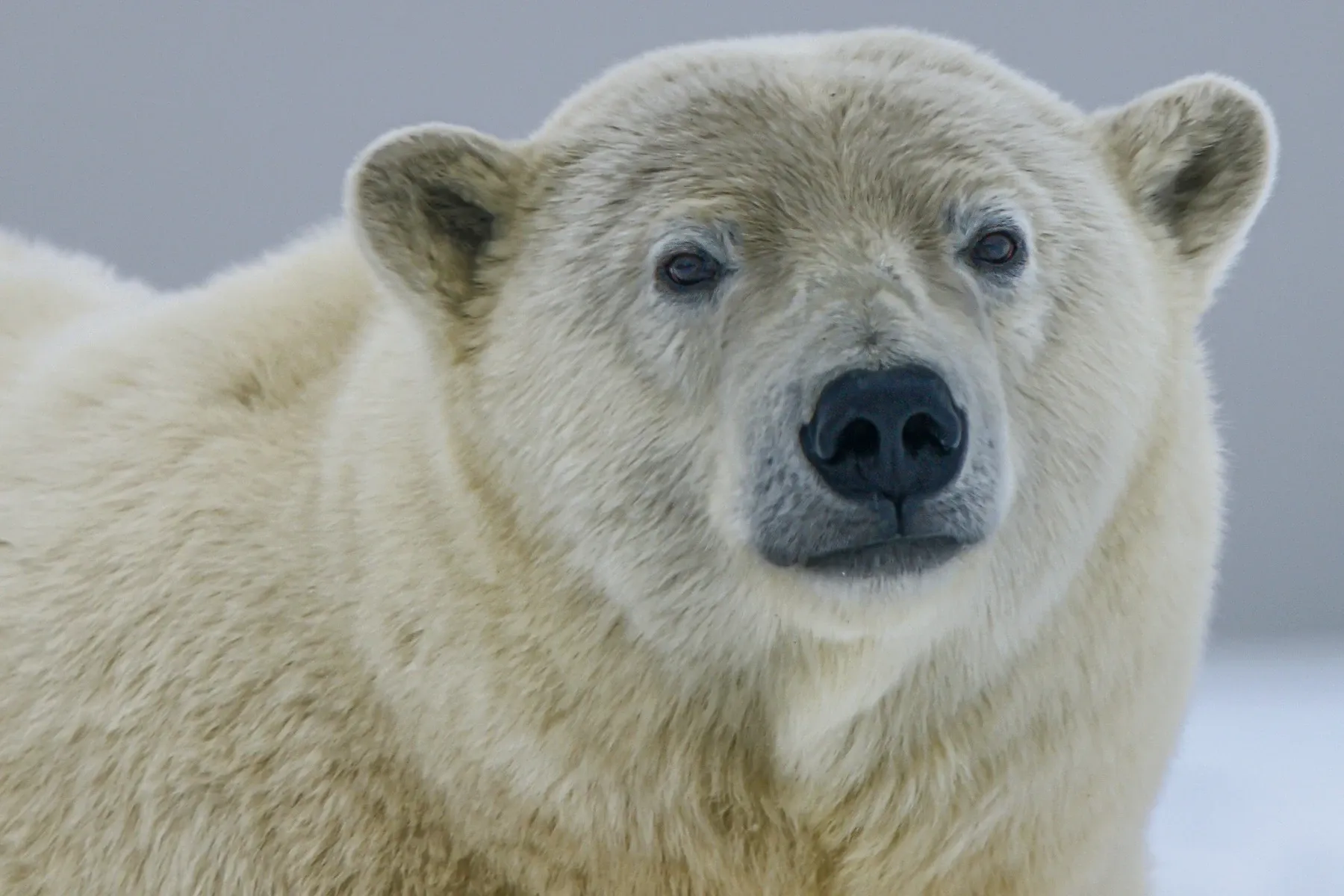
Few people get close enough to check, and nobody should try. But open a polar bear’s mouth and you may find a tongue that is not pink at all. In many adults it is dark, blotched or almost completely blue-black.
A tongue that darkens with age
According to Polar Bears International, a conservation group, cubs are born with pink tongues. After a few months, black patches start to appear. By adulthood the result varies: some bears keep plenty of pink, some have tongues so mottled they look blue, and some are nearly or entirely black.
Black underneath
The tongue matches what lies under the fur. A polar bear’s skin is black.
Why that helps is not fully settled. The leading ideas both involve the sun. Dark surfaces absorb more heat than pale ones, so black skin may help a bear soak up warmth on sunny days. Some sources add that it may protect against ultraviolet light, though the evidence for that in polar bears is thin.
Fur that isn’t white
The white comes from the fur, and the fur has no pigment. Each hair is transparent, and the longer guard hairs are hollow. They look white for the same reason snow does: clear material with many surfaces scatters light in every direction. That is also why the bears can look grey on dull days, or take on a warm tint at sunset.
The fibre-optic myth
In 1980, researchers suggested that the hollow hairs might work like fibre-optic cables, channelling ultraviolet light down to the black skin to warm it. The idea spread widely and is still repeated.
In 1998, a researcher, D. W. Koon, measured how much light actually travels along a polar bear hair. Almost none does. The hair’s own protein absorbs ultraviolet light instead of passing it on, which is why polar bears look dark, not bright, in ultraviolet photographs.
The takeaway
The Arctic’s most famous white animal is a black-skinned bear wearing clear fur, and sometimes a blue-black tongue. And a neat-sounding explanation, like solar-powered hair, can travel far without anyone checking it.
Sources & further reading
- 01Polar Bears International. Why do polar bears have black skin?
- 02Koon, D. W. (1998). Is polar bear hair fiber optic? Applied Optics, 37(15), 3198.
- 03University of Alaska Fairbanks, Geophysical Institute. Alaska Science Forum: Debunking a myth about polar bear hair.
- 04North American Bear Center. Myth: polar bears are solar.