The Five-Second Rule: What Really Decides How Dirty Dropped Food Gets
Bacteria don't wait five seconds before jumping onto dropped food. What matters more is what you dropped and what it landed on.
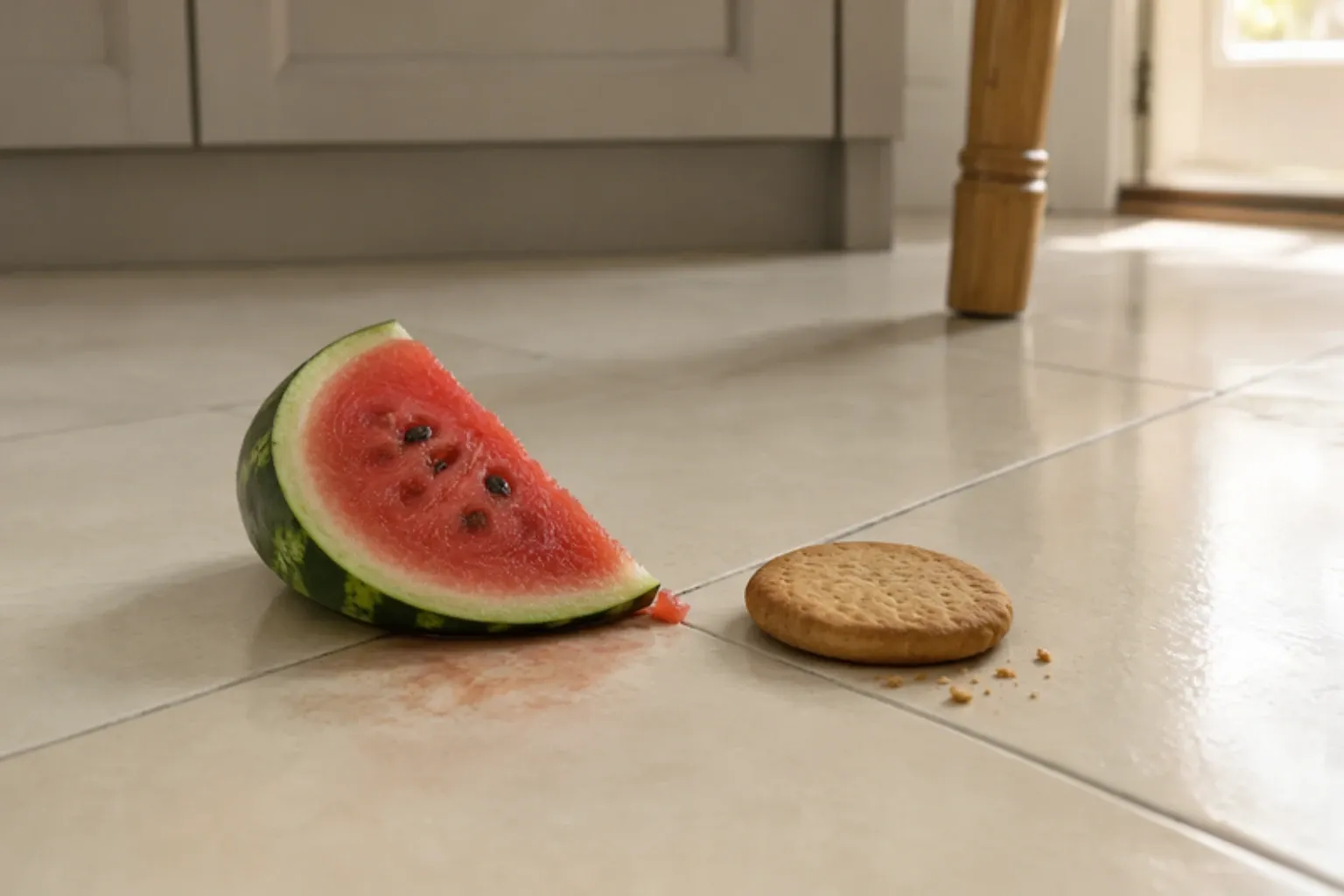
Drop a biscuit, snatch it back, announce “five-second rule”. Most of us have done it. The rule assumes bacteria need a moment to climb aboard. In 2016, two food scientists at Rutgers University tested that assumption, and it did not survive.
The experiment
Robyn Miranda and Donald Schaffner coated four surfaces with bacteria: stainless steel, ceramic tile, wood and carpet. They used a harmless food-grade species that sticks to surfaces in a similar way to Salmonella.
Then they dropped four foods onto them: watermelon, bread, buttered bread and gummy sweets. Each food rested for less than a second, 5 seconds, 30 seconds or 5 minutes. Every combination was repeated 20 times, giving 2,560 measurements.
What they found
Time did matter. Food left longer generally picked up more bacteria. But some transfer happened in under a second, which is enough to sink the rule.
The bigger influences were the food and the floor. Watermelon picked up more bacteria than anything else, up to about 97% of what was available in the worst cases. Its wet surface helps: moisture is known to make bacteria transfer more easily. Gummy sweets picked up the least. Bread fell in between, with results that varied more from drop to drop.
The surface mattered too. Carpet was surprisingly clean in this test. In most of the drops lasting less than a second, the researchers could not detect any bacteria at all on food dropped onto carpet. Tile and stainless steel passed bacteria on much more readily.
The authors concluded that the type of food and surface are of equal or greater importance than the time on the floor.
The fine print
The surfaces in the study were deliberately loaded with a large dose of bacteria and left to dry for five hours. That shows how transfer works, not how dirty a typical kitchen floor is. Whether a dropped snack makes you ill depends a great deal on what is on the floor in the first place.
The takeaway
Speed helps a little, but it is not the deciding factor. A dry biscuit dropped on carpet picks up far less than a slice of watermelon dropped on tiles, however quickly you grab it. Judge by what you dropped and where it landed, not by counting.
Sources & further reading
- 01Miranda, R. C. & Schaffner, D. W. (2016). Longer contact times increase cross-contamination of Enterobacter aerogenes from surfaces to food. Applied and Environmental Microbiology, 82(21), 6490–6496.
- 02Rutgers University (2016). Rutgers researchers debunk 'five-second rule': eating food off the floor isn't safe. News release.